You leave the house looking forward to a peaceful morning walk. Thirty seconds later your dog has spotted a squirrel, and you are being dragged across the pavement at a pace that would impress an Olympic sprinter. Sound familiar?
So! Stop Your Dog Pulling on the Lead
Dog Lead pulling is one of the most common behaviour challenges faced by UK dog owners — and one of the most frustrating. It makes walks unpleasant, exhausting, and sometimes genuinely dangerous. But here is the thing: it is also one of the most fixable problems with the right approach.
This guide walks you through exactly what causes pulling, why it gets worse if you ignore it, which equipment actually helps, and a step-by-step training method that works — even for determined, powerful breeds that have been pulling for years.
Why do dogs pull on the Lead/Leash in the first place?
Before you can fix pulling, it helps to understand why it happens. And the answer might surprise you — your dog is not being naughty, dominant, or deliberately difficult.
Dogs pull on the Lead simply because pulling has worked for them. Every time they have pulled forward and the walk continued, they learned that pulling gets them where they want to go. It is a classic reinforced behaviour — your dog tried something, it worked, so they kept doing it.
The world is an overwhelming place for a dog. Exciting smells, other dogs, squirrels, food wrappers on the pavement — everything is desperately interesting and it is all happening right now. Your dog wants to get to it as fast as possible. Pulling is just the most efficient strategy they have found.
The longer a dog has been pulling, the more ingrained the behaviour becomes — making it harder but not impossible to change. The good news is that dogs are always learning, and with consistency, even a dog that has pulled for years can learn to walk calmly on a loose dog Lead/dog leash .
The health risk most UK dog owners do not know about
Here is something important that deserves its own section, because most dog owners are genuinely unaware of it.
Pulling on a collar and Lead has been shown to increase the risk of permanent tracheal, laryngeal, oesophageal, and ophthalmic damage in dogs. In plain English: walking your dog on a collar while they pull can damage their windpipe, voice box, food pipe, and even their eyes — over time.
Research found that dogs experienced significantly higher intraocular pressure when force was applied to a collar rather than a harness, suggesting that dogs who pull on a collar may be at risk of visual field loss similar to that seen in humans with elevated eye pressure. Dogs Trust
A no-pull harness distributes force across the chest and shoulders — roughly a 50 times reduction in pressure per square centimetre compared to a collar, where all the force lands on approximately 4cm² of neck tissue. Cats Protection
This is not about making you feel guilty. It is about making sure you have the right information. If your dog pulls regularly, switching to a well-fitted harness is one of the most impactful things you can do for their long-term health — before any training begins.
Understanding the opposition reflex — why shouting or yanking makes it worse
Many owners instinctively pull back when their dog pulls forward. It feels logical. But it almost always backfires.
Dogs have a natural neurological response called the opposition reflex. When pressure is applied to one part of their body, they instinctively push back against it. It is the same reflex that makes sled dogs so effective — pressure on the harness triggers them to lean into it and pull harder.
When you pull back on the Leash, your dog’s opposition reflex kicks in and they pull against you with more force. You pull harder. They pull harder. Nobody wins — except the squirrel, which got away while you were both busy.
This is why punishment-based approaches and constant Lead yanking tend to make pulling worse, not better. The most effective approach works with your dog’s instincts rather than against them.
Step 1 — Get the right equipment before you start training
Training is far more effective with the right kit. Here is what actually works for UK dogs and owners in 2026.
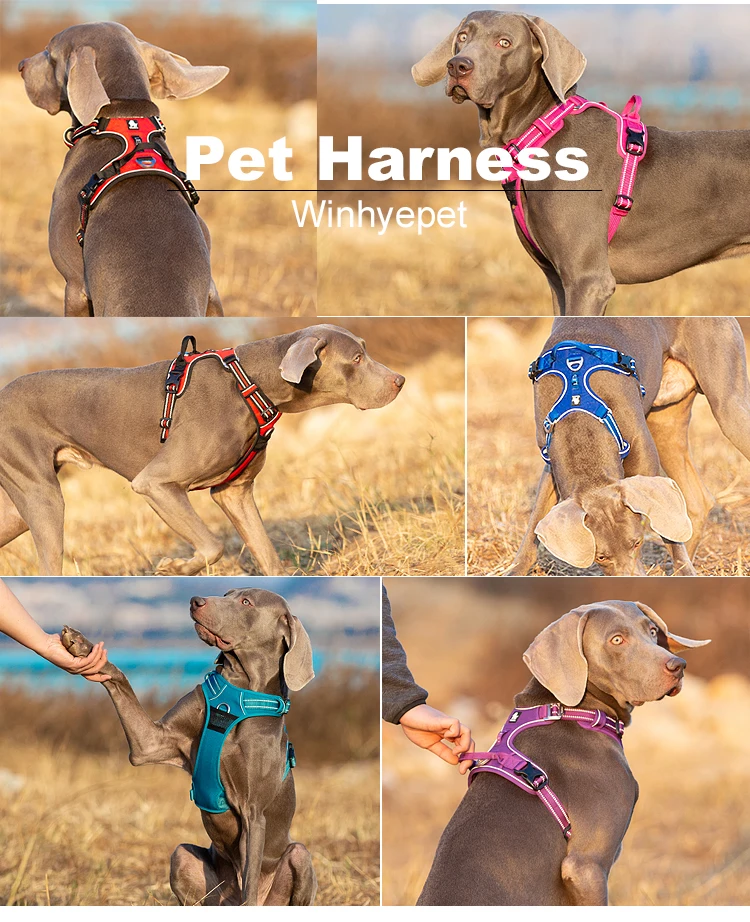
No-pull harness — the single best piece of equipment for a pulling dog
A no-pull harness with a front chest clip is the most effective piece of equipment for managing and training a dog that pulls. When a dog pulls while wearing a front-clip harness, the Lead attachment point on the chest redirects their forward momentum sideways rather than allowing them to lean into it and continue forward. This makes pulling physically less rewarding and much easier to manage. EzyDog
Look for these features in a no-pull harness for UK dogs:
- Front D-ring clip on the chest for training — this is the key anti-pull feature
- Back D-ring clip as well — so you can switch to back-clip walking once your dog improves
- Adjustable chest and neck straps — at least two adjustment points for a proper fit
- Padded chest plate — distributes pressure comfortably during redirections
- Reflective strips — essential for UK winter walks in low light
Our adjustable no-pull dog harness with lead is designed specifically for UK conditions — weatherproof, fully adjustable, with both front and back clip options for all sizes from small to large breeds.
How to measure your dog for a harness
Measuring correctly is essential. A poorly fitted harness will not work and can cause rubbing:
- Measure your dog’s neck girth — around the base of the neck where a collar would sit
- Measure your dog’s chest girth — the widest part of their chest just behind the front legs
- Add 2–3cm to each measurement for comfort
- Check our size guide for specific size recommendations by breed

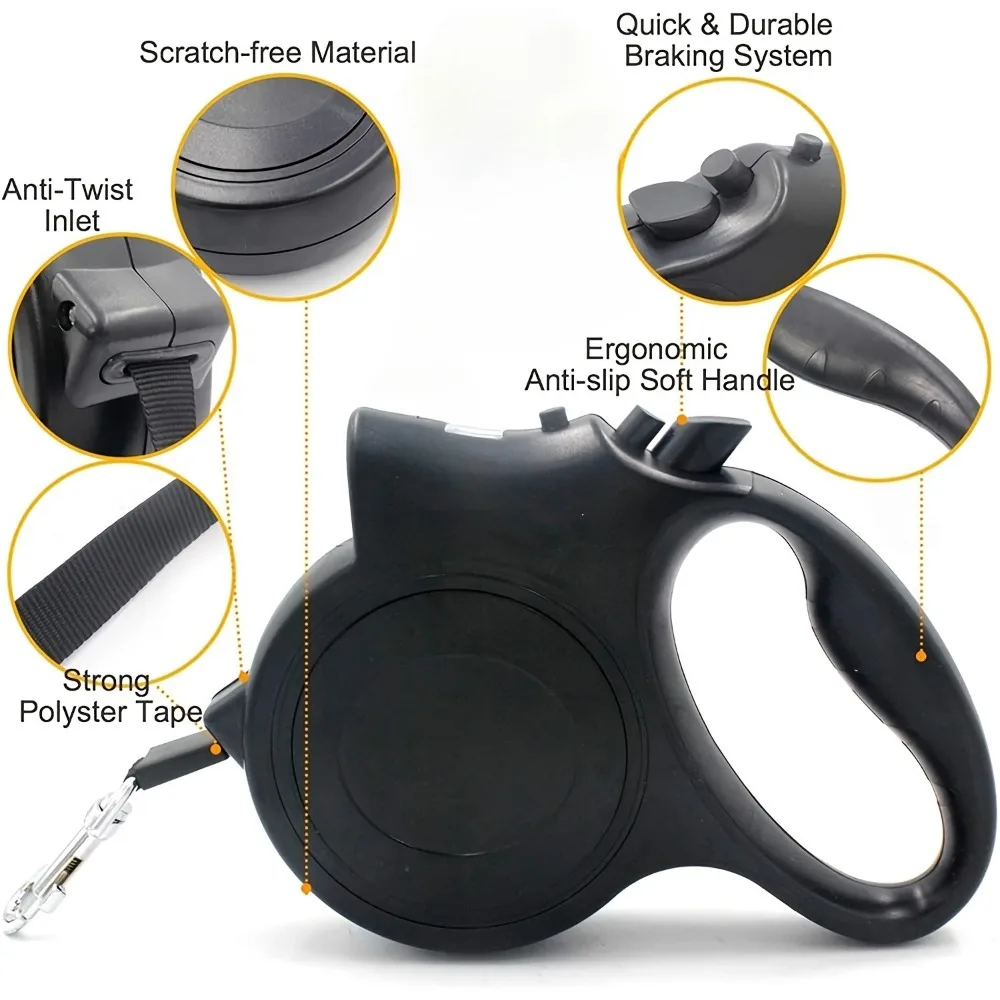
What about Retractable Dog Lead?
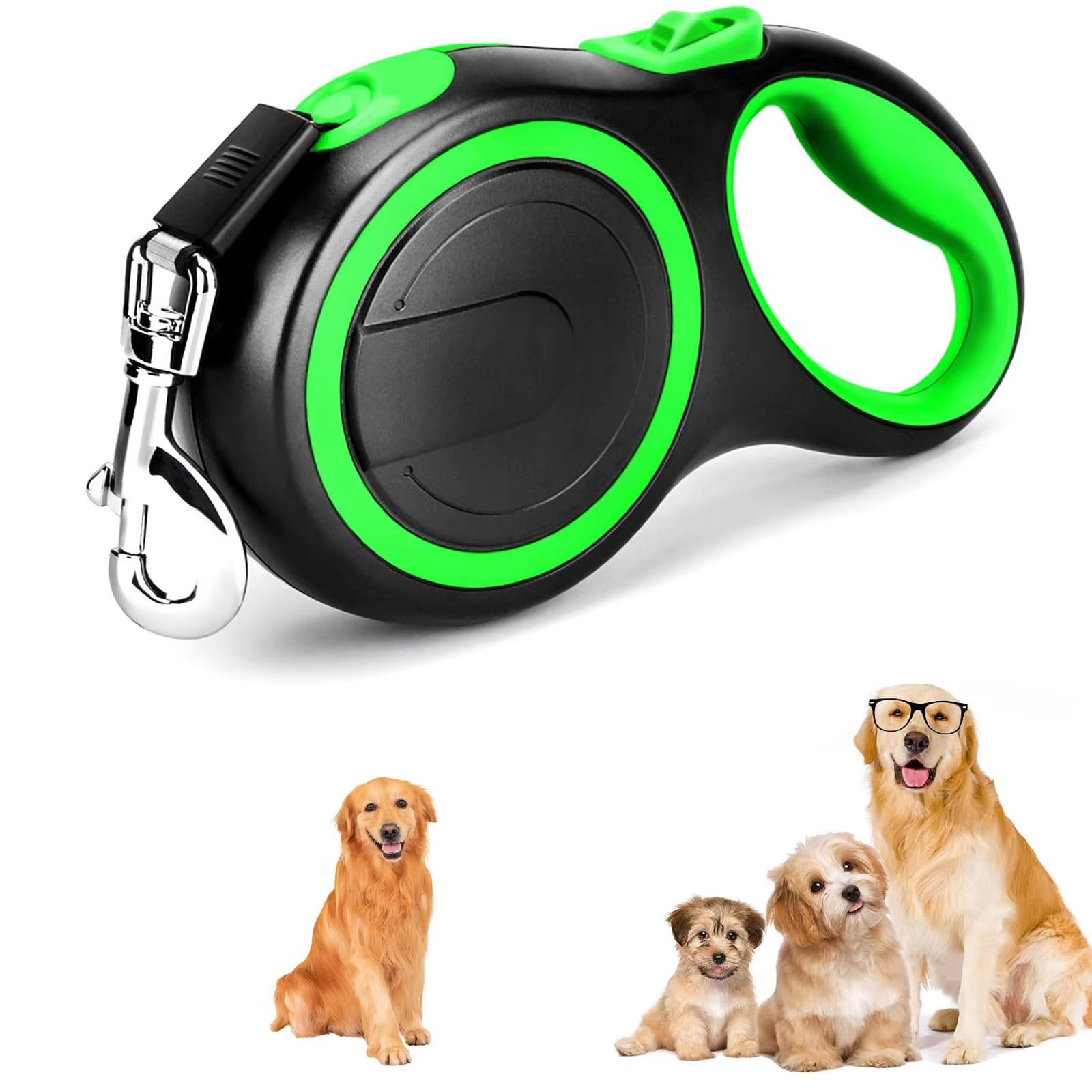
Professional trainers recommend a fixed-length Leash rather than a retractable one for training loose-lead walking. Retractable dog lead maintain constant tension, making it very difficult for a dog to distinguish between pulling and walking nicely.
Use a standard 1.2m to 1.8m fixed-length lead for training sessions. Once your dog reliably walks on a loose lead, a retractable dog Leash can be useful for giving them more freedom in open spaces. Our 3 in 1 retractable dog lead 5M with waste bag and light is perfect for this purpose.
What to avoid: Choke chains, prong collars, and figure-of-eight leashes. These devices work by causing pain or discomfort when a dog pulls, which is unnecessary and can be confusing and unpleasant for the dog. The Dogs Trust and RSPCA both advise against aversive equipment for leash training. PupClub Couture.
Step 2 — The stop and wait method
This is the foundation of loose-dog leash training and it is recommended by the RSPCA, Dogs Trust, and Blue Cross. It is simple, consistent, and genuinely effective.
How it works:
- Start walking with your dog on the lead
- The moment the dog lead becomes tight — the instant your dog starts pulling — stop completely
- Stand still and wait. Do not pull back, do not shout, do not move forward
- Wait for your dog to release the tension on the lead — this might take 30 seconds with a new learner
- The moment the leash goes slack, say “yes” in a calm, warm tone and walk forward again
- Repeat every single time the leash goes tight
The message you are sending your dog is clear and consistent: tension stops the walk, slack leash continues it. Dogs figure this out much faster than most owners expect.
The key is consistency. If you stop 80% of the time but let pulling go occasionally, your dog learns that sometimes pulling works — and they will keep trying.
Step 3 — The direction change method
Once your dog understands that pulling stops the walk, you can add direction changes to reinforce staying close to you.
- Walk forward in one direction
- When your dog begins to pull ahead, calmly turn and walk in the opposite direction
- Your dog has to turn with you — this naturally brings them back to your side
- The moment they are beside you, reward them with a treat delivered at your hip
This works particularly well for dogs that are distracted by things ahead of them. Instead of a battle of strength, you simply become more interesting than whatever they were pulling toward. Dogs are opportunistic — if turning toward you reliably results in a treat, they will start choosing to stay near you.
Step 4 — Reward loose-lead walking generously
This step is where many owners go wrong. They focus entirely on stopping pulling but forget to actively reward what they want — the dog walking calmly beside them.
When training with treats, always reward your dog next to your leg, not in front of you. If treats are delivered ahead, the dog learns that moving forward gets rewarded — which is the opposite of what you want. Cats Protection
Feed the treat at your hip, at the height of your dog’s nose when they are standing beside you. This teaches them that the golden zone — right next to you — is where the good things happen.
Use high-value treats for training, especially in distracting environments. Cheese, cooked chicken, or soft training treats are far more motivating than dry biscuits when there are squirrels involved.
Step 5 — Build duration and distance gradually
Do not expect miracles on day one. Loose-dog lead walking is a skill your dog needs to learn, just like any other.
Start training in your garden or a quiet room. Once your dog walks nicely there, progress to a quiet street. Then a slightly busier area. Then a park. Each new environment is more distracting, so treat it as if you are starting from the beginning.
A good training session is 5 to 10 minutes of focused practice, not a 45-minute walk where pulling gradually creeps back in. Short, frequent, consistent sessions produce faster results than occasional long ones.
The most common mistakes UK dog owners make
Mistake 1 — Being inconsistent between family members. If one person stops every time the dog pulls but another person lets it go, your dog receives mixed signals. Everyone in the household must follow the same rules on every walk.
Mistake 2 — Only training on training walks. Every walk is a training opportunity. The rules apply at 7am before work and on Sunday afternoon equally.
Mistake 3 — Using the wrong size harness. A harness that is too loose rotates around the body and loses all its anti-pull effectiveness. Measure carefully and re-check the fit monthly — puppies and young dogs change shape quickly.
Mistake 4 — Giving up after two weeks. Most dogs show meaningful improvement within 4 to 6 weeks of consistent training. Dogs that have been pulling for years may take 2 to 3 months. Progress is rarely linear — expect some bad days among the good ones. Tippaws
Which breeds pull the most?
Some breeds are genetically predisposed to pulling due to their original working roles. These include Siberian Huskies, Alaskan Malamutes, Border Collies, German Shepherds, Labradors, Staffordshire Bull Terriers, and Beagles. Huskies and Malamutes were literally bred to pull sleds — patience and consistency are especially important with these breeds.
However, any dog of any breed or size can learn to walk on a loose leash . Size is not a barrier — a pulling Chihuahua can be just as difficult to manage as a pulling Labrador, for different reasons.
What to do if your dog is a serious puller
If your dog’s pulling is severe — lunging, reacting to other dogs, or causing you pain — it is worth consulting a professional dog trainer in addition to the techniques above. Look for a trainer who uses force-free, reward-based methods and is accredited by the Association of Pet Dog Trainers UK (APDT) or the Institute of Modern Dog Trainers (IMDT).
Your vet is also a good first point of contact — they can rule out any underlying pain or discomfort that might be contributing to your dog’s behaviour on the leash .
Get the right equipment for calmer walks
Everything you need to start loose- dog lead training today is available at Affordium Shopping — from no-pull harnesses and fixed-length training leash to retractable leash for when your training starts paying off.
Browse our full dog collars, harnesses and dog leash/dog lead range with fast UK delivery on orders over £15. If you are unsure which harness size or type is right for your dog’s breed and weight, contact our team and we will help you choose.
For more dog training tips and UK pet care guides, visit the Affordium Shopping blog — updated every week with practical advice for UK dog and cat owners.